Abstract
Multimodal diffusion in latent space has emerged as one of the most important generative-modeling directions because it addresses three difficult problems simultaneously: the computational cost of high-dimensional diffusion, the representational misalignment between modalities, and the need to generate, condition on, or translate across multiple data streams without training a separate model for each task. The central idea is to replace direct diffusion in observation space with diffusion over compact latent variables learned by modality-specific or shared encoders, and to organize denoising as a conditional generative process over one or more modalities. This article develops the topic from first principles to current research frontiers. It formalizes latent diffusion mathematically, extends the formulation to multimodal settings, examines shared versus factorized latent spaces, reviews representative systems across image-text, audio-video, medical, and robotics-oriented settings, and identifies the main unresolved research problems: latent geometry, cross-modal consistency, missing-modality robustness, controllability, temporal structure, and scientific evaluation.
Introduction
Diffusion models have become central to modern generative modeling because they provide a flexible route from simple noise distributions to complex data distributions through iterative denoising. Yet their practical success has revealed two structural limitations. First, direct diffusion in observation space is computationally expensive, especially for images, video, audio, and multimodal tensors. Second, real generative tasks are often not unimodal. They involve conditioning, translation, or joint generation across text and image, audio and video, multiple medical imaging modalities, or language and action.
Latent diffusion addresses the first limitation by shifting the generative process into a compressed and semantically richer latent space [1]. Multimodal latent diffusion addresses the second by asking whether different modalities can be encoded into a compatible latent geometry so that diffusion can model their joint or conditional distribution [2-6]. This is not a trivial extension. It requires decisions about shared versus private factors, conditioning topology, temporal synchronization, and what counts as consistency across modalities.
As of November 2025, the field is no longer defined by image-only latent diffusion. The frontier includes unified text-image diffusion, audio-video latent diffusion, multimodal medical synthesis, transformer-based latent denoisers, and multimodal diffusion policies for robot behavior [2-7]. The scientific significance of this shift is that multimodal diffusion in latent space is not only a more efficient sampling strategy; it is a hypothesis about the structure of multimodal data itself.
From first principles
The conceptual starting point is simple. Suppose the data of interest are too large or too heterogeneous to diffuse directly. One may first learn a lower-dimensional representation and then run the diffusion process in that representation instead. If the representation preserves semantically relevant structure, diffusion becomes both cheaper and often more meaningful.
The multimodal case adds another layer. If the data come from multiple modalities, one must decide whether their latent representations should occupy a common space, partially shared spaces, or separate spaces linked only through conditioning. Each choice encodes a scientific assumption about what is common across modalities and what remains modality-specific.
This is why multimodal latent diffusion should be treated as a representation-learning problem before it is treated as a sampling problem.
Diffusion and latent diffusion: the mathematical foundation
Let \(x_0\) denote an observed sample and let \(z_0 = E(x_0)\) be its latent representation under an encoder \(E\). In a standard diffusion formulation, one defines a forward corruption process
where \(t \in \{1,\dots,T\}\) indexes diffusion time, \(\alpha_t\) controls signal retention, and \(\sigma_t\) controls noise magnitude. The reverse process is learned by a parameterized denoiser
optionally conditioned on auxiliary information \(c\), such as text, another modality, or a guidance signal.
In the noise-prediction parameterization popularized by DDPM-style training [8], the model is trained to predict the noise \(\epsilon\) used to corrupt \(z_0\):
Latent diffusion replaces diffusion in pixel or raw signal space by diffusion over \(z_t\), where the latent variable is produced by an autoencoder or related compression model [1]. This reduces computational burden while often improving semantic abstraction because the denoiser does not spend capacity on imperceptible or low-level detail.
The central mathematical point is that latent diffusion is not merely compression followed by diffusion. It is a coupled design problem. The geometry of \(E(\cdot)\) determines what diffusion sees as local, smooth, and denoisable.
Extending the formulation to multiple modalities
Let the modality set be \(\mathcal{M} = \{1,\dots,M\}\), with observations \(x_0^{(m)}\) for modality \(m\). Let \(E_m\) denote the encoder for modality \(m\), so that
There are several ways to construct a multimodal latent variable. A simple shared-latent model writes
where \(\Phi\) fuses modality-specific latents into one joint representation. A more structured alternative decomposes each modality into shared and private parts:
with an alignment objective encouraging the shared parts to carry cross-modal information.
The corresponding multimodal diffusion objective can be written as
The terms have distinct roles:
- \(\mathcal{L}_{\mathrm{diff}}\) trains the denoising process in latent space;
- \(\mathcal{L}_{\mathrm{align}}\) encourages cross-modal compatibility;
- \(\mathcal{L}_{\mathrm{rec}}\) preserves decodability into each modality;
- \(\mathcal{L}_{\mathrm{miss}}\) promotes robustness when some modalities are absent.
A common alignment term is
where \(P_m\) and \(P_n\) project modality-specific latents into a common comparison space and \(d\) is a distance or contrastive dissimilarity.
The mathematical challenge is now clear: multimodal latent diffusion requires a latent space that is simultaneously compressive, denoisable, decodable, and cross-modally coherent.
Architectural choices and their scientific assumptions
The architecture of a multimodal latent diffusion system is not a secondary implementation detail. It expresses a theory about multimodal structure.
Shared latent spaces
In a shared-latent architecture, all modalities are mapped into a common latent manifold. This is attractive when one believes the modalities are different projections of the same underlying semantic or physical content. It is especially natural in text-image generation, cross-modal retrieval, or aligned medical modalities.
Factorized shared-private spaces
A factorized model assumes that some structure is shared while some is modality-specific. This is often more realistic. For example, video and audio may share event semantics while still retaining private details such as timbre or fine-grained motion texture. Likewise, paired medical modalities may share anatomy but differ in contrast-specific physics.
Cross-attentional conditioning
Many systems do not force a fully shared latent space. Instead, they diffuse one latent while conditioning through cross-attention on another modality. This design weakens the alignment requirement and often improves flexibility. It is common in text-conditioned image generation and in image-conditioned variations [4].
Transformer denoisers in latent space
Transformers have become increasingly important as latent diffusion backbones because latent tokens can be processed as sequences or patch sets. Diffusion Transformers (DiTs) demonstrated that transformer scaling works well in latent diffusion settings [9]. This matters especially for multimodal systems because transformers provide a natural substrate for cross-modal attention and token mixing.
Table 1. Major design choices in multimodal latent diffusion
| Design choice | Scientific assumption | Strength | Main risk |
|---|---|---|---|
| fully shared latent space | modalities reflect one common latent semantics | clean cross-modal translation and unified denoising | over-forces alignment and erases modality-specific information |
| shared-plus-private factorization | modalities share only part of their structure | balances commonality and modality specificity | optimization becomes more delicate |
| cross-attentional conditioning | one modality can guide denoising of another without full latent fusion | flexible and often strong in practice | latent coherence may remain weak |
| transformer latent denoiser | tokenized latent structure captures long-range dependencies | scalable and naturally multimodal | expensive attention and training instability |
| missing-modality objective | latent space should remain usable under partial observation | practical multimodal robustness | may weaken fidelity if the objective is poorly balanced |
Representative systems and research trajectories
The field has developed through several notable trajectories.
Ho, Jain, and Abbeel established the DDPM formulation that turned diffusion into a practical and highly effective generative framework [8]. Song et al. then unified score-based modeling and diffusion through stochastic differential equations, clarifying the continuous-time viewpoint and broadening the theoretical apparatus [10]. Rombach et al. made latent diffusion computationally viable at scale by showing that diffusion in an autoencoded latent space can preserve quality while reducing cost [1].
The multimodal extension followed several paths. Versatile Diffusion proposed a unified multi-flow framework over text and images, showing that multimodal diffusion need not be restricted to a single directional task such as text-to-image generation [4]. Multi-Modal Latent Diffusion formalized diffusion directly in a multimodal latent space, with emphasis on shared multimodal representation rather than conditioning alone [2]. MM-LDM extended multimodal latent diffusion to audio-video generation, where cross-modal coherence and temporal structure are central [5]. In robotics, the Multimodal Diffusion Transformer brought diffusion-based multimodal modeling into goal-conditioned behavior learning, linking latent diffusion ideas to control rather than only to synthetic media generation [7].
Recent work on latent transparency and layered generation further indicates that structured latent spaces can support richer compositional generation than ordinary unconditional synthesis [11]. This is significant because it suggests that latent diffusion can model not just content, but also structured relations among content layers.
A practical formulation for multimodal latent diffusion
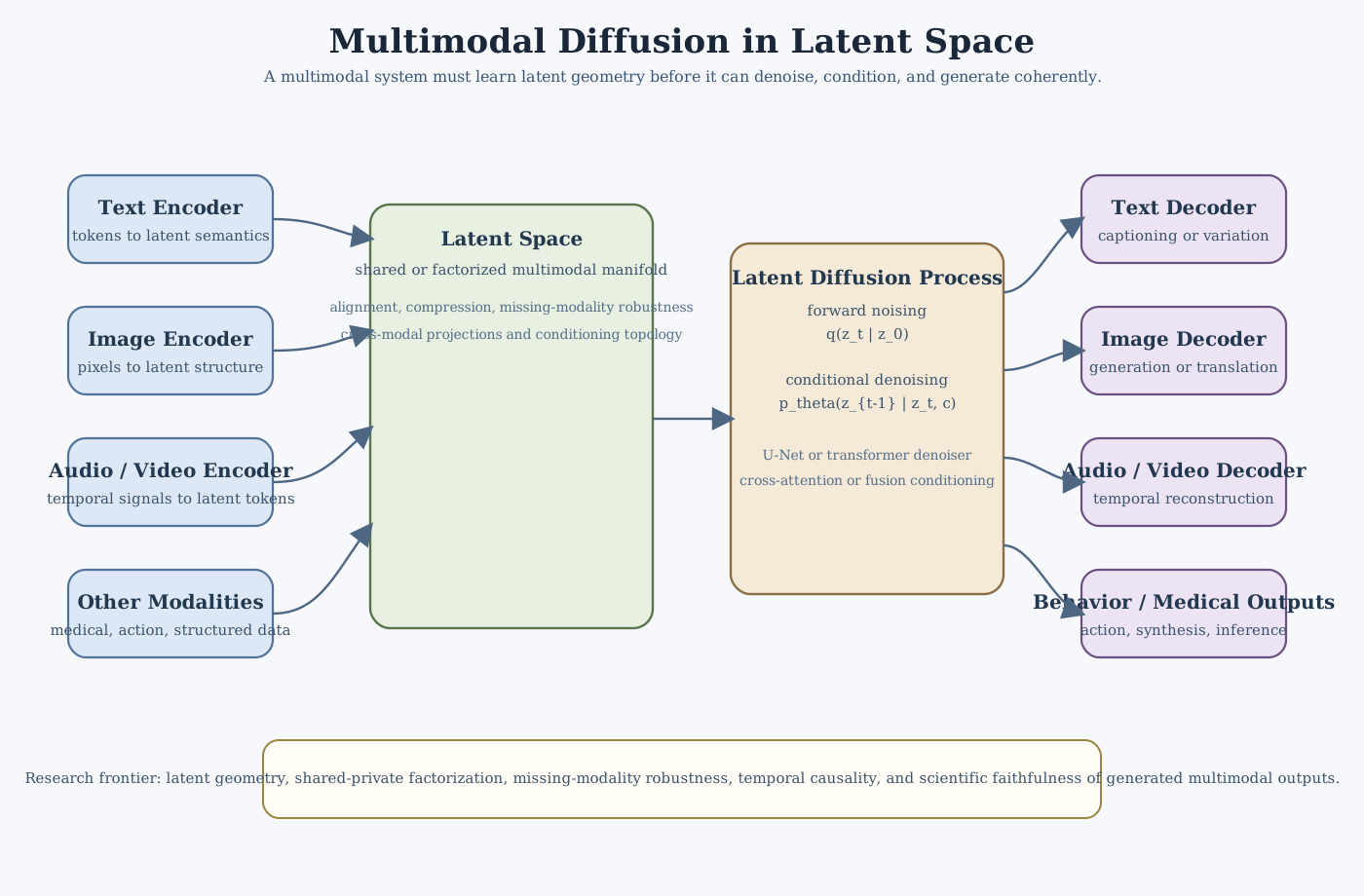
The most useful general-purpose formulation today is a modality-conditional latent diffusion system with explicit handling of missing modalities and alignment pressure. A high-level computational graph looks like this:
- encode each modality into a latent variable;
- fuse or align the latent variables;
- corrupt the latent representation according to the diffusion schedule;
- denoise conditioned on the available modalities and task context;
- decode into one or more output modalities.
A compact implementation sketch is below.
import torch
import torch.nn.functional as F


class MultimodalLatentDiffusion:
    def __init__(self, encoders, denoiser, decoders, projectors):
        self.encoders = encoders
        self.denoiser = denoiser
        self.decoders = decoders
        self.projectors = projectors

    def encode(self, batch):
        return {m: self.encoders[m](batch[m]) for m in batch}

    def align_loss(self, latents):
        mods = list(latents.keys())
        loss = 0.0
        for i in range(len(mods)):
            for j in range(i + 1, len(mods)):
                zi = self.projectors[mods[i]](latents[mods[i]])
                zj = self.projectors[mods[j]](latents[mods[j]])
                loss = loss + F.mse_loss(zi, zj)
        return loss

    def loss(self, batch, noise_scheduler):
        latents = self.encode(batch)
        z0 = torch.cat([latents[m] for m in sorted(latents)], dim=-1)
        t, eps, zt = noise_scheduler.sample_noisy_latent(z0)
        eps_hat = self.denoiser(zt, t, latents)
        diff_loss = F.mse_loss(eps_hat, eps)
        align_loss = self.align_loss(latents)
        return diff_loss + 0.1 * align_loss
This sketch omits most engineering complexity, but it exposes the main ideas: modality-specific encoding, latent aggregation, diffusion in latent space, conditioning on multimodal context, and explicit alignment regularization.
Why latent space matters in the multimodal setting
The value of latent-space diffusion in multimodal modeling is not only efficiency. It provides a controlled location in which multimodal structure can be defined.
In raw data space, the modalities can be too heterogeneous for a single denoiser to process effectively. Text is discrete, images are spatial, audio is temporal, video is spatiotemporal, and medical modalities may differ in physical acquisition principles. The latent space acts as a representational negotiation layer. If it is well designed, diffusion can operate on variables that are semantically richer, geometrically smoother, and more comparable across modalities.
This is why the quality of the latent representation frequently determines the quality of the downstream diffusion process. A poor latent space can make denoising computationally easy but semantically shallow. A strong latent space can make multimodal generation more coherent, controllable, and data-efficient.
Applications
The application space is already broad.
Text-image and image-text generation
Multimodal latent diffusion has been especially influential in text-image modeling because language provides semantic conditioning while latent diffusion provides scalable image synthesis. Unified models such as Versatile Diffusion demonstrate that the same architecture can support multiple cross-modal tasks rather than only one-way generation [4].
Audio-video generation
Joint audio-video generation is a natural test case because the modalities are tightly coupled but not identical. MM-LDM shows that latent-space diffusion can improve tractability while still modeling cross-modal consistency [5].
Medical multimodal generation
Medical imaging is an important domain because multimodal synthesis is often clinically meaningful rather than purely aesthetic. Multi-Modal Latent Diffusion and related work show how latent diffusion can be used to connect complementary imaging modalities or compare generative quality across modalities [2, 3].
Multimodal behavior generation
In robotics and control, multimodal diffusion is increasingly used for behavior learning from goal images, language, and other conditioning channels. The Multimodal Diffusion Transformer illustrates how diffusion in a structured latent space can be used to represent action distributions rather than only media generation [7].
Research frontiers
Latent geometry
What makes a latent space "good" for multimodal diffusion? Compactness is not enough. The geometry must support denoising, alignment, and decodability simultaneously. This remains poorly understood in general.
Missing-modality robustness
Real multimodal systems rarely observe every modality at inference time. Strong systems will need latent spaces that degrade gracefully when one or more modalities are absent.
Temporal and causal structure
Many multimodal settings are temporally coupled: audio-video, language-action, sensor-fusion, and robotics. Future systems will need latent spaces that encode not only static semantics, but causal and temporal structure.
Controllability and scientific faithfulness
As multimodal diffusion moves into medicine, science, and robotics, high perceptual fidelity is not sufficient. The generated content must remain faithful to physically or clinically meaningful structure. This demands new evaluation protocols beyond generic perceptual scores.
Scaling with transformers
Transformer denoisers appear highly promising, but the scaling laws for multimodal latent diffusion are still poorly mapped relative to their unimodal counterparts. The relation between latent-token granularity, cross-modal attention topology, and generation quality remains an open problem.
Interpretation
Multimodal diffusion in latent space should be understood as a convergence of three ideas: diffusion as a powerful generative transport process, latent representation learning as a computational and semantic abstraction layer, and multimodal modeling as a hypothesis that different data streams can be organized by shared structure.
This perspective is stronger than treating multimodal diffusion as a collection of engineering tricks. The design choices of encoder family, latent factorization, alignment loss, denoiser backbone, and conditioning strategy are all scientific commitments about the organization of multimodal information.
Conclusion
Multimodal diffusion in latent space has become a central research direction because it addresses the computational, representational, and generative challenges of modern multimodal learning within one framework. The field has already progressed from basic latent diffusion to genuinely multimodal systems spanning text, image, video, medical imaging, and behavior generation. The next phase will likely be determined by deeper understanding of latent geometry, stronger handling of missing modalities, more explicit temporal and causal structure, and evaluation criteria that move beyond perceptual plausibility toward scientific and operational faithfulness.
That is why the topic matters. It is not only a powerful method family. It is a developing theory of how multimodal structure should be represented, denoised, and generated.