Abstract
Simulation is indispensable in robotics, but simulation alone is not evidence. A robot can look excellent in a simulator and fail immediately in the real world because friction, delay, sensing, contact, congestion, or human behavior were modeled badly. This article argues that the correct response is not to abandon simulation but to reframe it as a digital twin that is continuously calibrated from runtime traces. In that view, simulation becomes an evolving experimental instrument: good enough to support design, comparison, and failure analysis, but always answerable to physical data. The article develops the mathematical logic of calibration, shows how this changes implementation practice, and explains why runtime-calibrated twins are becoming central to serious sim-to-real robotics.
Introduction
The sim-to-real problem is sometimes described as a gap. That description is too passive. In real engineering, the gap is created by modeling choices: unmodeled contact effects, latency, actuator saturation, sensor bias, scene simplification, missing human behavior, poor traffic generation, and countless other approximations. The problem is therefore not simply that simulation differs from reality. The problem is that simulation becomes stale while the deployment environment keeps teaching us new facts.
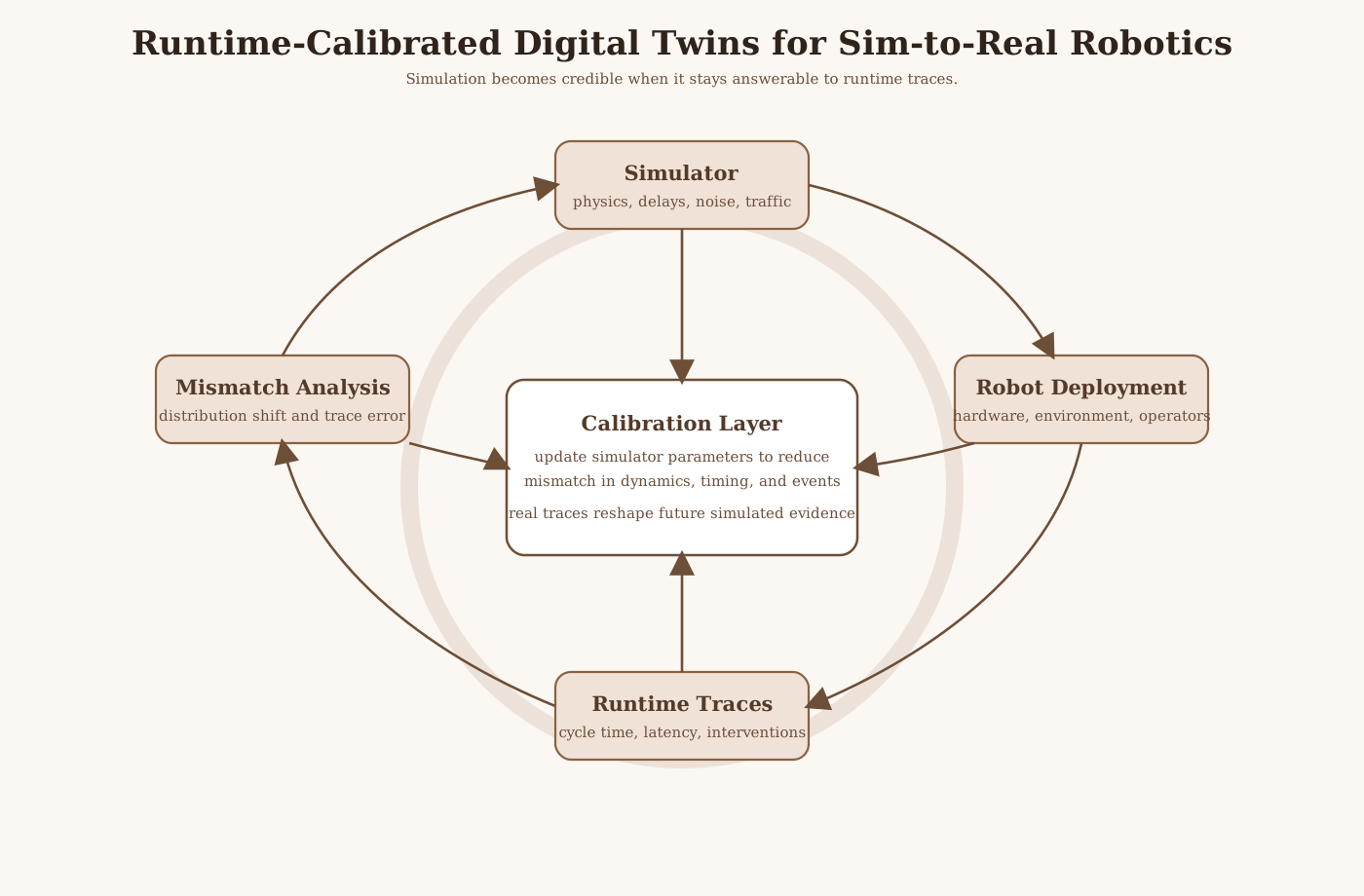
The digital twin is the right idea when it is understood correctly. A twin is not merely a visual simulator. It is a digital representation that remains linked to the physical system through data and model revision. For robotics, the strongest version of that idea is runtime calibration: the simulator is periodically updated so that its distributions, delays, and event structure better match observed traces.
From first principles
The simplest useful distinction is between a simulator and a twin. A simulator generates plausible behavior. A twin remains accountable to a specific physical system. That accountability matters because robotics decisions are often made from simulated evidence: controller comparisons, safety envelopes, sample-efficient learning, and failure analysis all depend on what the simulated world permits or hides.
Once that distinction is clear, runtime calibration becomes natural. Real traces are not only validation data collected after the fact; they are corrections to the digital model itself.
From simulator to calibrated twin
Let \(\theta_{\mathrm{sim}}\) denote the simulator parameter vector. It may include friction coefficients, latency distributions, perception noise, traffic arrival processes, human reaction models, or contact parameters. Let \(z^{\mathrm{real}}\) be a real trace and \(z^{\mathrm{sim}}(\theta)\) the corresponding simulated trace. Calibration can be written as
where \(\mathcal{D}\) is a trace discrepancy functional.
In this equation, \(\theta_{\mathrm{sim}}\) collects the simulator parameters to be estimated, \(z^{\mathrm{real}}\) is the observed physical trace, and \(z^{\mathrm{sim}}(\theta)\) is the trace produced by the simulator under candidate parameters. The optimization therefore asks a concrete engineering question: which simulator settings make the virtual system reproduce the measured behavior most faithfully?
This basic expression is extremely important because it turns simulation into a learnable artifact. The twin is no longer a fixed environment. It is a model that can be tuned against evidence.
The discrepancy term should not be a single scalar unless the task is trivial. In robotics, useful mismatch terms often include
For intralogistics, \(\mathcal{D}_{\text{events}}\) might measure queue build-up, deadlock incidence, and service times. For manipulation, it may emphasize contact onset and slip. For mobile robotics, it may focus on localization drift, obstacle encounters, or planner latency.
Why domain randomization is not enough
Domain randomization was a major advance because it taught robotics to train over families of simulators rather than a single nominal world [1, 2]. But randomization alone does not guarantee relevance. A simulator family can still miss the dominant real mismatch.
Runtime calibration adds a second discipline: not only should the model vary, it should vary in directions supported by real traces. This is why recent sim-to-real methods increasingly combine randomized training with system identification, calibration, or real-to-sim adaptation [3, 4].
A twin should model distributions, not only means
A frequent mistake in robotics calibration is to match only average behavior. That is not enough. If the real system shows bursty delays, heavy-tailed queue lengths, intermittent sensing failures, or occasional slip, the twin should reproduce those distributions because control policies often fail in the tails, not at the mean.
Suppose \(y\) is a metric of interest such as cycle time or control latency. A stronger target is not merely
but
This observation makes the calibration problem richer, but also more honest. Matching means is a basic requirement; matching distributions is the more advanced requirement because robotic failures often live in tail events, bursts, and rare timing coincidences.
Table 1. Typical calibration targets in robotics digital twins
| Calibration target | Why it matters | Typical observable |
|---|---|---|
| actuation and kinematics | affects path tracking and contact timing | pose traces, wheel slip, joint lag |
| sensing and perception | affects state estimation and planning | false detections, latency, missing observations |
| environment dynamics | affects task realism | congestion, obstacle appearance, human motion |
| compute timing | affects controller feasibility | loop rates, inference latency, queue delay |
| rare events | determines robustness | deadlocks, emergency stops, recovery behavior |
Implementation sketch
The twin pipeline should make trace comparison first-class. The following example shows the logic at a high level.
import numpy as np


def summarize_trace(trace):
    return {
        "mean_cycle_time": np.mean(trace["cycle_time"]),
        "p95_cycle_time": np.percentile(trace["cycle_time"], 95),
        "mean_latency_ms": np.mean(trace["control_latency_ms"]),
        "deadlock_rate": np.mean(trace["deadlock"]),
    }


def mismatch(real_summary, sim_summary, weights):
    total = 0.0
    for key, w in weights.items():
        total += w * abs(real_summary[key] - sim_summary[key])
    return total


def select_best_parameters(candidates, real_trace, simulator, weights):
    real_summary = summarize_trace(real_trace)
    best_theta = None
    best_score = float("inf")
    for theta in candidates:
        sim_trace = simulator.run(theta)
        sim_summary = summarize_trace(sim_trace)
        score = mismatch(real_summary, sim_summary, weights)
        if score < best_score:
            best_theta = theta
            best_score = score
    return best_theta, best_score
This is only a scaffold, but it captures the right mindset. The simulator is not accepted because it is plausible. It is accepted temporarily because it minimizes an explicit mismatch against observed data.
Interpretation
Runtime-calibrated twins matter in three ways.
First, they improve the quality of controller comparison. If the simulation environment is badly misaligned, the comparison between methods is only weakly informative. Second, they improve failure analysis. When a field failure appears, the twin can be adjusted and replayed, turning an anecdote into an experiment. Third, they improve data efficiency. Real experiments are expensive; a calibrated twin lets each real trace update a larger experimental asset.
This is one reason recent robotics and manufacturing work increasingly connects digital-twin methods to experimental validation rather than visualization alone [5, 6].
Where weak twin programs fail
The failure modes are now familiar:
- the simulator is calibrated once and then never updated;
- only means are matched while tails are ignored;
- the twin omits compute and communication delays;
- human behavior is treated as noise rather than as structured interaction;
- or the calibration target is chosen for convenience rather than control relevance.
The result is a model that is impressive in a paper but operationally stale.
Conclusion
Runtime-calibrated digital twins are the right evolution of sim-to-real robotics because they preserve the power of simulation while submitting it to evidence. The simulator becomes neither a fantasy world nor a full substitute for reality. It becomes a revisable experimental partner.
That is a stronger scientific position than either simulator optimism or simulator rejection. As robotics systems become more adaptive and more data-rich, the most useful twins will be the ones that stay in dialogue with runtime behavior.