Abstract
Perception, intelligence, machine learning, and robotics are frequently treated as neighboring research areas, yet in embodied systems they are more accurately understood as coupled components of a single scientific problem. The problem is to determine how an agent should sense the world, infer latent structure, decide under uncertainty, and act so that future observations and future states become jointly more informative and more useful. This article develops that intersection as a research synthesis from foundational formulation to current frontiers. The central argument is that perception should be treated as inference under partial observability, intelligence as predictive and actionable model formation, machine learning as the representational and adaptive bridge between sensing and control, and robotics as the physical closure of the loop through intervention in the world. On that basis, the article connects classical estimation and control to contemporary research on multimodal perception, world models, vision-language-action systems, cross-embodiment learning, active perception, uncertainty-aware control, and future directions in physically grounded robot intelligence.
Introduction
The contemporary robotics literature contains many strong local advances: perceptual models with high recognition accuracy, learned policies with impressive imitation capacity, planners with strong optimization performance, and large multimodal models with growing semantic competence. The unresolved problem is not whether these components can be individually improved, but how they should be coupled so that the resulting embodied system remains coherent, adaptive, and scientifically interpretable. A capable robot must transform noisy and partial sensory streams into an actionable internal state, combine prediction with control, and remain effective when the operational environment departs from the support of the training distribution. For this reason, the intersection of perception, intelligence, machine learning, and robotics has become one of the most consequential research directions in embodied AI.
As of December 2025, the frontier is no longer defined primarily by isolated perception modules or isolated control laws. It is increasingly defined by integrated embodied systems: language-conditioned robot policies, multimodal world models, cross-embodiment pretraining, diffusion-based action generation, and robots that use perception not only to react, but also to select actions that improve subsequent inference [1-9]. This shift is scientifically significant because it changes the unit of analysis from the individual module to the closed-loop embodied system.
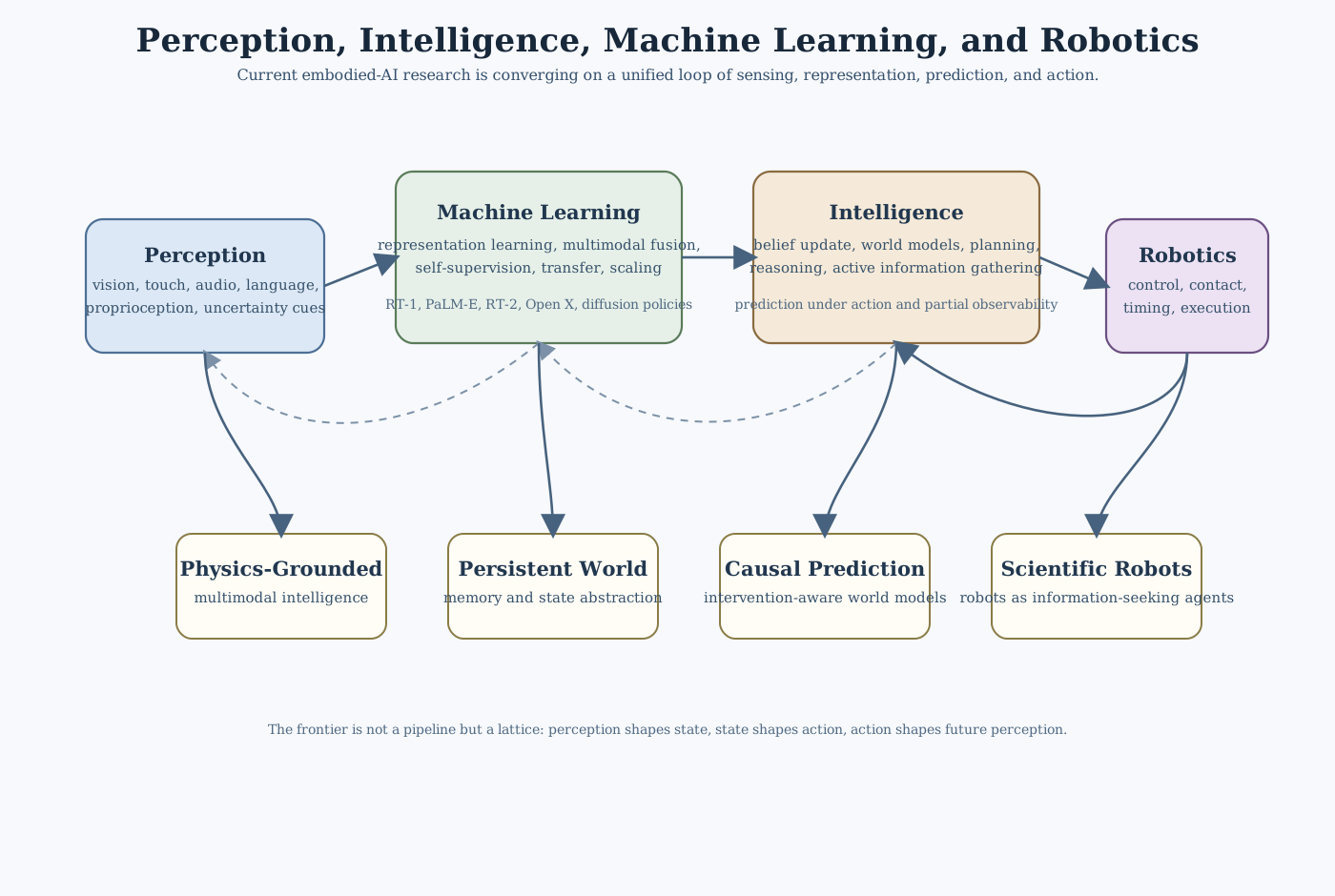
The central claim of this article is that the relevant scientific object is an adaptive embodied system. In such a system, perception produces internal state, intelligence organizes prediction and decision, machine learning provides scalable representation and adaptation, and robotics closes the loop through action in the physical world. The narrative therefore proceeds in three stages: first, by establishing a common scientific formulation; second, by locating current research programs within that formulation; and third, by identifying the forward research agenda implied by this convergence.
From first principles
At the most basic level, a robot faces four questions.
First, what is in the world right now? That is the perception problem. Second, what does the world state mean for future outcomes? That is the intelligence problem in its predictive sense. Third, how can the system improve these mappings from data and experience? That is the machine-learning problem. Fourth, how should the system act under physical constraints, uncertainty, and delayed consequences? That is the robotics problem.
These questions are analytically distinct, but physically inseparable. A robot that perceives poorly cannot reason reliably. A robot that reasons well but cannot update from data will fail under novelty. A robot that learns but cannot respect physical constraints becomes unsafe. A robot that acts without improving its own information state remains perceptually passive and therefore strategically weak.
The historical progression of the field makes this coupling visible. Classical robotics emphasized estimation and planning under uncertainty [1]. Behavior-based robotics emphasized situated action and reactivity. Deep visuomotor learning demonstrated that perception and control can be trained jointly [2]. Foundation-model-era robotics has extended the question further by asking whether perception, semantics, reasoning, and action can be embedded within a shared representational framework [5-8]. The substantive scientific question is therefore no longer whether these components interact, but how they should be coupled so that the resulting system is both effective and intelligible.
A unified formulation
Let \(x_t\) denote the latent physical state of the environment, \(y_t\) the sensory observation, \(a_t\) the executed action, and \(g\) a task specification or goal. A general embodied system can be written as
where \(b_t\) is the robot's internal belief state. The critical point is that \(b_t\) is not the world itself. It is the system's current representation of the world, inferred from incomplete evidence.
In Bayesian form, the belief update is
where \(\eta\) is a normalization constant. This equation provides one of the clearest mathematical bridges between perception and intelligence. The observation model \(p(y_t \mid x_t)\) captures sensing, while the transition model \(p(x_t \mid x_{t-1}, a_{t-1})\) captures embodied dynamics. Intelligence, in this view, is not an abstract reasoning layer detached from embodiment; it is the structured updating of belief under action.
In learned systems, the belief is often replaced by a latent representation
with a learned dynamics model
and a policy
The notation matters. The encoder \(f_\theta\) compresses sensory history into a task-relevant state. The world model \(F_\phi\) predicts how that state evolves under action. The policy \(\pi_\psi\) chooses actions from the internal state. When these components are learned jointly, machine learning becomes the mechanism by which perception, prediction, and control share a common representational substrate.
Perception is inference, not only recognition
Much of contemporary robotics still treats perception principally as recognition: classify the object, estimate the pose, segment the scene. These are important tasks, but they do not exhaust what perception contributes to embodied intelligence.
Perception in robotics is more appropriately viewed as an inference process under partial observability. The robot does not merely require labels; it requires state estimates with uncertainty, temporal consistency, and action relevance. This is why probabilistic robotics remains foundational even in the era of deep learning [1]. It formulated perception and control within a shared uncertainty-aware mathematical language.
This perspective also explains the renewed importance of active perception. If action changes future information quality, then perception itself becomes partly a control problem. A useful objective is
where \(r\) is task reward, \(c\) is execution cost or risk, and \(\mathcal{I}(x_{t+1}; y_{t+1} \mid a_t)\) is the action-conditioned information gain. The first two terms express ordinary control logic; the third expresses active information gathering. Bajcsy, Aloimonos, and Tsotsos argued that a complete agent necessarily includes active perception [3]. That argument has only become stronger as robots move into less structured environments.
Intelligence in robotics is predictive and actionable
In embodied systems, intelligence is best understood operationally. It is the capacity to construct internal models that support useful action over time. This definition is narrower than broad philosophical accounts and more demanding than treating intelligence as classification or language completion alone.
A powerful way to formalize this is through world models. Instead of mapping observation directly to action, the system learns a latent predictive model and uses that model to evaluate future consequences. Modern world-model research, from latent state-space methods to DreamerV3, shows that learned predictive structure can support broad control competence across tasks [4, 10].
The scientific importance of world models lies in the way they reconnect contemporary machine learning to classical questions in control and estimation:
- what state abstraction is sufficient for planning?
- what uncertainty should be carried forward?
- what future quantities should be predicted?
- and what causal structure is stable across tasks and embodiments?
This is a more demanding notion of intelligence than next-step reaction. It requires the robot to maintain an internal model that is useful for both interpretation and action.
Machine learning as the bridge
Machine learning is central here because hand-engineering every relevant representation has become intractable. Modern robots absorb image streams, depth, touch, force, proprioception, audio, language instructions, maps, task history, and fleet data. The representational burden is too large for manual feature design alone.
Machine learning contributes in at least four distinct ways.
First, it learns compact perceptual representations from high-dimensional data. Second, it supports multimodal fusion across sensing channels. Third, it provides policies and value functions for action selection. Fourth, it enables transfer across tasks, objects, and embodiments when training data are sufficiently diverse.
The strongest current systems illustrate these roles with unusual clarity. RT-1 showed that large real-world robot datasets can support scalable language-conditioned control [5]. PaLM-E demonstrated that continuous sensor streams and language can be incorporated into a single embodied multimodal model [6]. RT-2 extended this line toward vision-language-action reasoning with web-scale knowledge transfer [7]. Open X-Embodiment pushed the field toward cross-robot learning rather than single-platform specialization [8]. Diffusion Policy showed that generative action modeling can be highly effective for visuomotor behavior [9].
Table 1. Current research frontier at the intersection of perception, intelligence, machine learning, and robotics
| Research Direction | Core Scientific Idea | Current Strength | Current Limitation |
|---|---|---|---|
| multimodal robot perception | fuse vision, language, touch, and state into one representation | richer grounding and better context use | synchronization, missing modalities, calibration |
| world models | learn latent predictive structure for planning and control | sample efficiency and long-horizon reasoning | model error, rollout drift, causal ambiguity |
| vision-language-action systems | align semantics with action generation | broad task generalization and instruction following | latency, grounding failures, safety guarantees |
| cross-embodiment learning | transfer structure across robots and datasets | reuse of data and broader priors | embodiment mismatch and action-interface inconsistency |
| generative policies | model action distributions rather than single deterministic commands | strong multimodal behavior and manipulation competence | inference cost and constraint handling |
| active perception and uncertainty-aware control | couple information gain with task reward | better robustness under partial observability | difficult credit assignment and evaluation burden |
A practical formulation for adaptive embodied systems
The most useful present-day architecture is neither purely reactive nor purely symbolic. It is a layered embodied learner with four interacting modules:
- a perception encoder that turns multimodal observations into latent state;
- a predictive model that estimates future latent trajectories;
- a decision module that chooses actions or plans from latent state;
- a supervisory layer that handles uncertainty, safety, and intervention.
One can write the joint training objective as
The terms have distinct roles. \(\mathcal{L}_{\mathrm{rep}}\) shapes the perceptual representation, often through reconstruction, contrastive alignment, or masking. \(\mathcal{L}_{\mathrm{dyn}}\) trains the predictive world model. \(\mathcal{L}_{\mathrm{ctrl}}\) trains the policy or planner, through imitation, reinforcement learning, or a mixture of both. \(\mathcal{L}_{\mathrm{unc}}\) encourages calibrated uncertainty or confidence estimation. \(\mathcal{L}_{\mathrm{safe}}\) enforces collision, contact, latency, or intervention constraints.
This decomposition is practically useful because it avoids a common conceptual mistake: treating embodied intelligence as if it were only an action-learning problem. In real robots, the representation, predictive, and supervisory terms are equally consequential.
Implementation sketch
The following code is schematic rather than production-ready, but it shows the engineering logic of a system that couples perception, world modeling, and action.
import torch
import torch.nn.functional as F


class EmbodiedAgent:
    def __init__(self, perception, world_model, policy, uncertainty_head):
        self.perception = perception
        self.world_model = world_model
        self.policy = policy
        self.uncertainty_head = uncertainty_head

    def encode(self, batch):
        return self.perception(batch["rgb"], batch["depth"], batch["state"], batch["language"])

    def loss(self, batch):
        z_t = self.encode(batch)
        z_next_pred = self.world_model(z_t, batch["action"])
        action_pred = self.policy(z_t, batch["goal"])
        uncert = self.uncertainty_head(z_t)

        rep_loss = batch["rep_loss_fn"](z_t)
        dyn_loss = F.mse_loss(z_next_pred, batch["z_next_target"])
        ctrl_loss = F.mse_loss(action_pred, batch["action_target"])
        unc_loss = batch["uncertainty_loss_fn"](uncert, batch["error_target"])
        safe_loss = batch["safety_loss_fn"](action_pred, batch["safety_margin"])

        return rep_loss + dyn_loss + ctrl_loss + 0.1 * unc_loss + 0.2 * safe_loss
This pattern matters because it makes the coupling explicit. The same latent state is used for prediction, action, and uncertainty. That is a stronger design than training isolated modules that never share representational structure.
Current research directions
The current research frontier at this intersection can be organized around six themes.
Multimodal grounding
Robots increasingly require more than RGB vision. Force, touch, proprioception, language, and environment state all matter. The central problem is no longer only perception quality; it is perceptual alignment. A robot should know that a spoken instruction, a visual affordance, and a force transient may describe the same unfolding event.
Vision-language-action integration
The vision-language-action line of work is significant because it attempts to fuse semantics and control within one model family [6, 7]. Its scientific value does not lie in language as a trend, but in the possibility that language introduces abstraction, compositionality, and task transfer into robot control. The open question is how much of this abstraction survives contact with physical execution.
Predictive intelligence through world models
World models are re-centering planning and control around latent prediction rather than direct regression from observation to action [4, 10, 11]. This research direction is especially promising for long-horizon tasks, interactive manipulation, and data-efficient adaptation.
Cross-embodiment scaling
Open X-Embodiment and related work suggest that robot learning may benefit from the same kind of scale logic seen in language and vision, but only if the data are aligned across embodiments, action spaces, and task semantics [8]. This remains one of the hardest unsolved problems in robot learning.
Generative action models
Diffusion-style policies are important because many robot tasks have multimodal action solutions [9]. In manipulation, there may be several valid grasps or several equally good paths. Generative models capture that plurality better than deterministic regressors.
Uncertainty-aware embodied control
A future-capable robot cannot merely act confidently. It must know when its internal state is fragile, underspecified, or shifted relative to prior experience. This is where uncertainty estimation, active perception, and safety-aware control reconnect modern machine learning to the older scientific core of robotics.
Future research agenda
The next phase of the field is likely to be defined less by larger policies alone than by richer internal structure. Several directions appear especially consequential.
Persistent world memory
Many current robot systems reason over short contexts. Future systems will need persistent memory tied to places, objects, task history, and human preferences. This is not only a scaling problem. It is a state-representation problem.
Physics-grounded multimodal intelligence
Vision-only intelligence will remain insufficient for dexterous and contact-rich robotics. Touch, force, audio, vibration, and proprioception will need to be integrated into the same inferential framework as vision and language. The strongest future systems will reason about contact, compliance, and failure before they are visually obvious.
Causal and intervention-aware world models
Current predictive models are often strong correlational learners. Future systems need models that support intervention reasoning: what changes if the robot pushes, grasps, yields, waits, or asks for clarification? This is where causal abstraction may become central to robot intelligence.
Self-supervised fleet learning
Large robot fleets and long-lived workcells produce streams of multimodal interaction data. The field is likely to move toward self-supervised robot learning from these streams, with adaptation occurring continuously rather than only in centralized offline retraining.
Scientific robotics
A particularly important and still underdeveloped direction is the robot as scientific instrument. In laboratories, agriculture, climate monitoring, and healthcare, the robot may become an embodied inference engine that decides not only how to manipulate the world, but also which measurements to acquire next because they maximize scientific information gain.
Human-aware embodied intelligence
Future robotics will need to model humans not only as obstacles, but as collaborators, teachers, and sources of uncertainty. This requires perception and reasoning over timing, intent, trust, ergonomic burden, and interaction adaptation.
Interpretation
The broadest lesson is that the field should no longer ask whether perception, intelligence, machine learning, and robotics should be integrated. They are already integrated in any nontrivial embodied system. The real question is which form of integration yields scientifically grounded, robust, and practically useful embodied intelligence.
A weak integration strategy treats machine learning as a drop-in replacement for classical modules. A stronger strategy treats learning as a representational bridge that connects sensing, prediction, decision, and action while preserving uncertainty, safety, and physical constraints. That is the direction in which the most serious current research is moving.
Conclusion
The intersection of perception, intelligence, machine learning, and robotics is now the core of embodied AI research because none of these components can achieve their full meaning in isolation. Perception without predictive intelligence is reactive. Intelligence without grounded perception is abstract and brittle. Machine learning without embodiment is disconnected from physical consequence. Robotics without adaptive learning struggles under novelty.
The scientific task, then, is to design adaptive embodied systems whose internal representations are rich enough to support inference, prediction, language grounding, uncertainty handling, and safe action in the physical world. That task is not a distant aspiration. It is already the organizing problem of current embodied-AI research, and it is likely to define the most consequential robotics work of the coming decade.