Classical signal processing provides the indispensable foundation for work on physiological data: acquisition, sampling, filtering, spectral estimation, time-frequency localization, and morphology-aware detection. Yet modern physiological data analysis increasingly operates in regimes where classical assumptions are strained or explicitly violated. Signals are nonstationary across state and behavior, contaminated by time-varying artifacts, recorded as mixtures rather than isolated sources, coupled across organ systems, and generated by latent processes that are only partially observed. Under these conditions, the central task is no longer merely to transform a measured waveform into a more convenient representation. It is to infer dynamic structure, hidden state, interaction, and uncertainty from signals that are both biologically rich and observationally imperfect.
That transition defines the domain of advanced signal processing. The term should not be taken to mean only algorithmic sophistication. In a serious research context, advanced signal processing refers to methods that enrich the representational and inferential model beyond fixed linear, stationary, single-channel analysis. The motive is not methodological novelty for its own sake, but the need for models whose assumptions are better aligned with the signal-generating processes of physiology.
This article is written as a continuation of the preceding foundation piece on classical signal concepts. The earlier article established the signal-theoretic core. The present article asks what follows once those foundations are understood and their limitations become explicit. The intended audience is expert: engineers and researchers who want a deeper synthesis of adaptive filtering, multiresolution analysis, blind source separation, state-space and Bayesian methods, nonlinear and complexity-oriented methods, sparse and inverse formulations, and emerging multimodal perspectives. The argument throughout is that advanced processing should be justified by inferential necessity, not by methodological fashion.
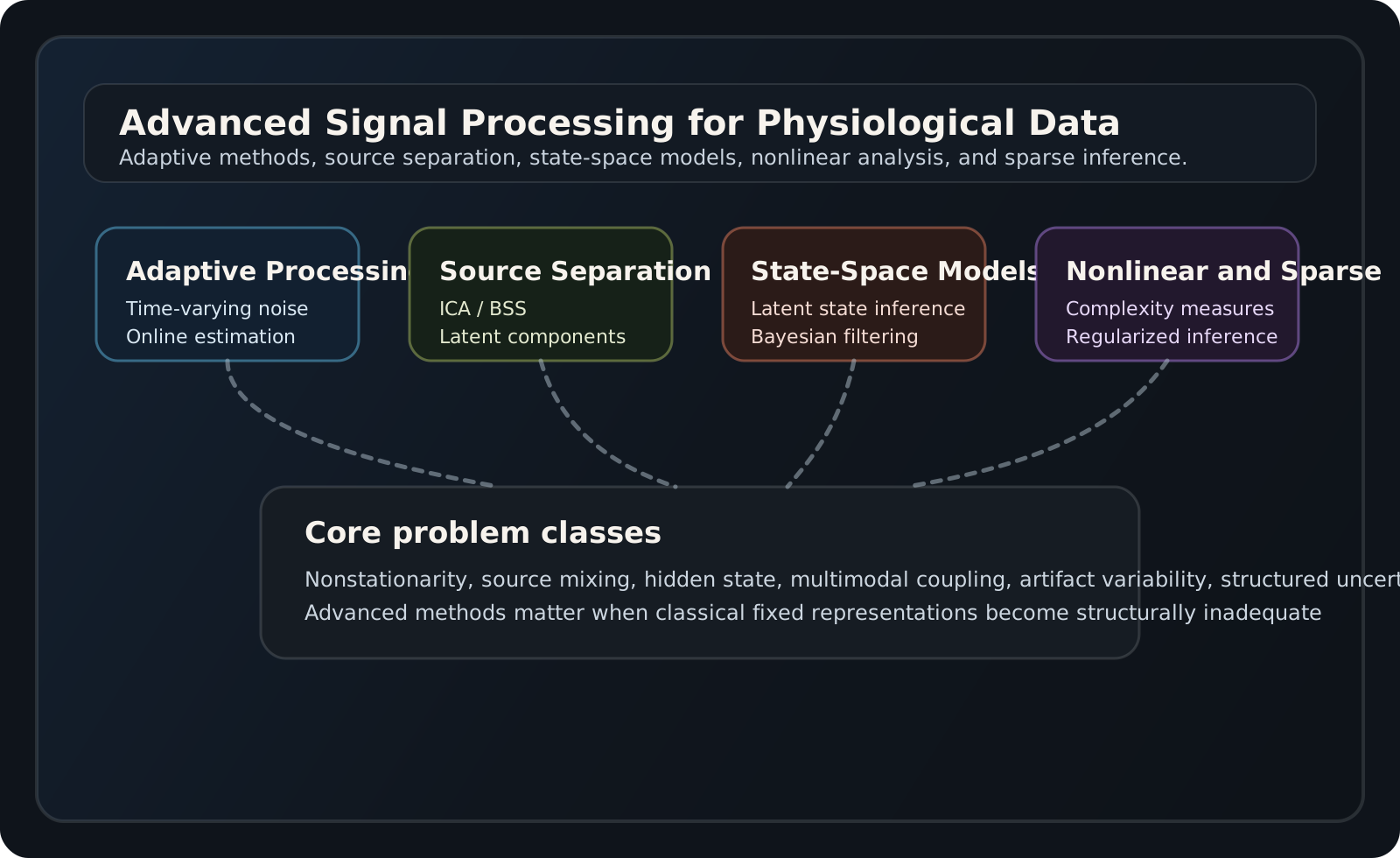
From classical representations to richer inferential models
The most productive way to understand the move from classical to advanced processing is as a controlled relaxation of assumptions. Classical methods often begin with some combination of approximate stationarity over an analysis window, fixed linear preprocessing, single-channel or weakly coupled observations, global or pre-specified basis representations, and decision rules expressed through thresholds or matched structures.
These assumptions are often defensible, and in many settings they remain the right ones. However, physiological data frequently challenge them at a structural level. ECG morphology changes under movement and pathology. EEG channels contain mixtures of cortical and non-cortical sources. Wearable PPG is corrupted by nonstationary motion artifacts. Multimodal monitoring reflects changing cardiorespiratory and neurovascular coupling. In such settings, the correct question is not “What advanced method is available?” but rather “Which assumption has failed, and what model class repairs that failure most faithfully?”
A common unifying expression for advanced formulations is
where \(x_t\) is a latent physiological state, \(u_t\) is an external or endogenous drive, \(w_t\) is process uncertainty, and \(y_t\) is the observed measurement. Different advanced methods can then be interpreted as different choices about how to represent \(f\), how to model \(h\), and how to infer \(x_t\) from noisy, mixed, and often incomplete observations.
Adaptive signal processing: beyond fixed filters
Adaptive methods are among the most natural extensions of classical filtering. They arise when the disturbance structure or signal statistics cannot be assumed known a priori. Classical optimal filters depend heavily on prior statistical knowledge, whereas adaptive filters update online in response to incoming data.
In its canonical least-mean-squares form,
where \(\mathbf{w}_n\) is the coefficient vector, \(\mu\) is the adaptation gain, \(e[n]\) is the instantaneous estimation error, and \(\mathbf{x}[n]\) is the input vector. This update is mathematically elementary but conceptually profound: the filter is no longer fixed, and signal processing becomes recursive estimation under uncertainty.
For physiological signals, adaptive methods matter whenever contamination is nonstationary or when a meaningful reference signal exists. Examples include motion-artifact suppression in wearable PPG, interference cancellation when a correlated reference channel is available, fetal ECG extraction from abdominal mixtures, adaptive line-noise removal, and multichannel spatial filtering in electrophysiology.
Their strengths are clear: online adjustment, reduced dependence on fixed noise models, and explicit treatment of changing signal conditions. Their weaknesses are equally important for experts: adaptation can lock onto the wrong structure, become numerically unstable, or suppress physiology alongside artifact if the optimization target is poorly aligned with the scientific objective.
Implementation sketch: adaptive noise cancellation
import numpy as np

T = 4000
mu = 0.01
order = 8

reference = np.random.randn(T)
artifact = np.convolve(reference, np.array([0.6, -0.2, 0.1]), mode="same")
physio = np.sin(np.linspace(0, 40 * np.pi, T))
observed = physio + artifact

w = np.zeros(order)
clean = np.zeros(T)

for n in range(order, T):
    x = reference[n - order:n][::-1]
    y_hat = np.dot(w, x)
    e = observed[n] - y_hat
    w = w + mu * e * x
    clean[n] = e
The example is intentionally spare. Its role is to make the conceptual structure visible: a reference channel, a time-varying artifact estimate, and a residual interpreted as the physiological signal of interest.
Time-frequency and multiresolution methods
The Fourier transform remains indispensable, but advanced physiological analysis often requires localized or adaptive representations. The short-time Fourier transform,
already departs from global stationarity by localizing analysis in time. Even so, it imposes a fixed time-frequency tradeoff determined by the analysis window. That tradeoff can be suboptimal for signals whose important structure varies strongly in scale.
Wavelet methods address this by shifting from a global sinusoidal basis to scaled and shifted atoms:
Wavelets are valuable for physiological data when transient and oscillatory structures coexist, local morphology matters, artifacts occupy different scales than the signal of interest, and denoising must preserve sharp or irregular structures. For expert practice, the important point is not that wavelets are “better” than Fourier methods. The point is representational alignment.
Blind source separation and independent component analysis
Many physiological channels are better understood as mixtures than as direct source measurements. EEG is the clearest example, though similar logic applies to multimodal surface recordings, abdominal ECG, and certain invasive measurements. A standard linear mixture model is
where \(\mathbf{s}(t)\) is the latent source vector, \(A\) is the mixing matrix, and \(\mathbf{n}(t)\) is additive disturbance. Blind source separation seeks to estimate \(\mathbf{s}(t)\) without direct knowledge of \(A\).
Independent component analysis became one of the most influential solutions to this problem in physiological signal analysis. For an expert audience, the key conceptual point is that ICA changes the analytical object. The channel is no longer taken as primary. The component becomes the unit of interpretation. This matters in ocular and muscle artifact removal in EEG, decomposition of task-related or seizure-related dynamics, separation of mixed physiological oscillations, and preprocessing for connectivity or event-related analyses.
The corresponding caution is equally important. ICA solves a statistical separation problem under model assumptions. It does not guarantee physiological truth. Component interpretation requires topology, temporal structure, domain knowledge, and validation.
State-space and Bayesian formulations
If adaptive filters generalize fixed filters, state-space methods generalize signal processing itself. Here the aim is no longer only to transform or denoise a signal, but to infer latent physiological state over time. This matters in any setting where the scientifically relevant object is not the measurement but the underlying regulatory process.
The general form,
supports a wide family of estimators: Kalman filters for approximately linear-Gaussian dynamics, extended or unscented filters for mild nonlinearity, particle filters for more general nonlinear and non-Gaussian regimes, and modern learned state-space variants when analytic models are insufficient.
For physiological signals, state-space formulations are powerful because they separate latent state from measured waveform, incorporate exogenous drives and perturbations, carry uncertainty explicitly, and support forecasting, tracking, and sensor fusion. They also align naturally with systems physiology, in which observed signals are outputs of hidden regulatory processes rather than self-sufficient analytical objects.
Nonlinear dynamics and complexity-oriented analysis
Advanced signal processing in physiology is not only about adaptive estimation or latent-state inference. It is also about the analysis of signals that reflect irregular, multiscale, nonlinear regulation. Healthy physiology is not characterized by maximal regularity, but by structured complexity across scales. This remains a crucial insight because it warns against equating reduced variability with cleaner or healthier system behavior.
Methods motivated by nonlinear dynamics include entropy-based statistics, fractal and scaling measures, nonlinear state-space reconstruction, recurrence analysis, and related complexity metrics. These approaches can be deeply informative, but only under strong methodological discipline. Advanced analysis does not reduce the need for engineering rigor; it increases it.
Data-adaptive decompositions and empirical mode methods
One of the most interesting extensions beyond fixed-basis representations is empirical mode decomposition and related adaptive decomposition families. These methods aim to decompose nonstationary, nonlinear signals into intrinsic mode functions defined by the data itself rather than by a pre-specified basis. This has made them attractive in physiological analysis, where fixed basis functions may fail to align with strongly time-varying structure.
The appeal of these methods is clear: they are adaptive, local, and often empirically effective. Their limitation is equally clear: theoretical guarantees and interpretation are often weaker than in better-established transform frameworks. They are useful additions to the methodological toolkit when classical fixed-basis or short-time methods are structurally misaligned with the data, but they require unusually careful validation.
Sparse representations, inverse problems, and regularization
Another major direction in advanced signal processing is the use of structured inverse formulations:
where \(A\) is the forward operator and \(\mathcal{R}(x)\) is a regularizer encoding structure such as sparsity, smoothness, or low rank. These formulations are central when the measured data are incomplete, ill-conditioned, or indirect.
In physiology, such methods matter for denoising in sparse transform domains, source localization, inverse imaging, compressed or accelerated sensing, and reconstruction under artifact or missingness. The expert issue is not whether regularization improves numerical stability. It almost always does. The deeper issue is whether the chosen prior reflects the actual structure of the physiological signal, or whether it imposes an attractive but misleading geometry on the problem.
| Method Family | Main Modeling Move | Typical Physiological Use | Principal Limitation |
|---|---|---|---|
| Adaptive filtering | Online parameter estimation | Nonstationary artifact removal and reference-channel cancellation | Can converge to the wrong target |
| Wavelets and multiresolution | Scale-dependent local representation | Transient analysis, denoising, morphology study | Interpretation can become heuristic |
| ICA and BSS | Latent source unmixing | EEG artifact removal and source decomposition | Statistical independence is not physiological identity |
| State-space and Bayesian methods | Latent-state inference under uncertainty | Tracking, sensor fusion, forecasting | Strong model assumptions can dominate results |
| Nonlinear and complexity methods | Characterization of irregular dynamical structure | HRV complexity and instability analysis | Highly sensitive to preprocessing and validation choices |
| EMD and adaptive decompositions | Data-driven decomposition into intrinsic modes | Nonlinear and nonstationary decomposition | Mode mixing and interpretation remain difficult |
| Sparse and inverse methods | Regularized reconstruction from incomplete observations | Denoising, localization, compressed acquisition | Priors may bias interpretation |
What changes for expert practice
The move from classical to advanced methods should not be understood as a change in sophistication level alone. It is a change in inferential ambition. Expert practice asks different questions: is the signal stationary enough for the representation being used; is the channel a meaningful object or merely a mixture of latent sources; is the disturbance process fixed or time-varying; is the phenomenon of interest better represented as a latent state, a component, a coupling regime, or a nonlinear signature; and does the method's gain in expressive power justify the cost in identifiability, interpretability, and validation burden?
This is where many applied studies fail. Advanced methods are often introduced because they are powerful, but power without identifiability is not scientific strength. The more flexible the model class, the more essential it becomes to validate assumptions, stress-test interpretations, and separate numerical performance from physiological plausibility.
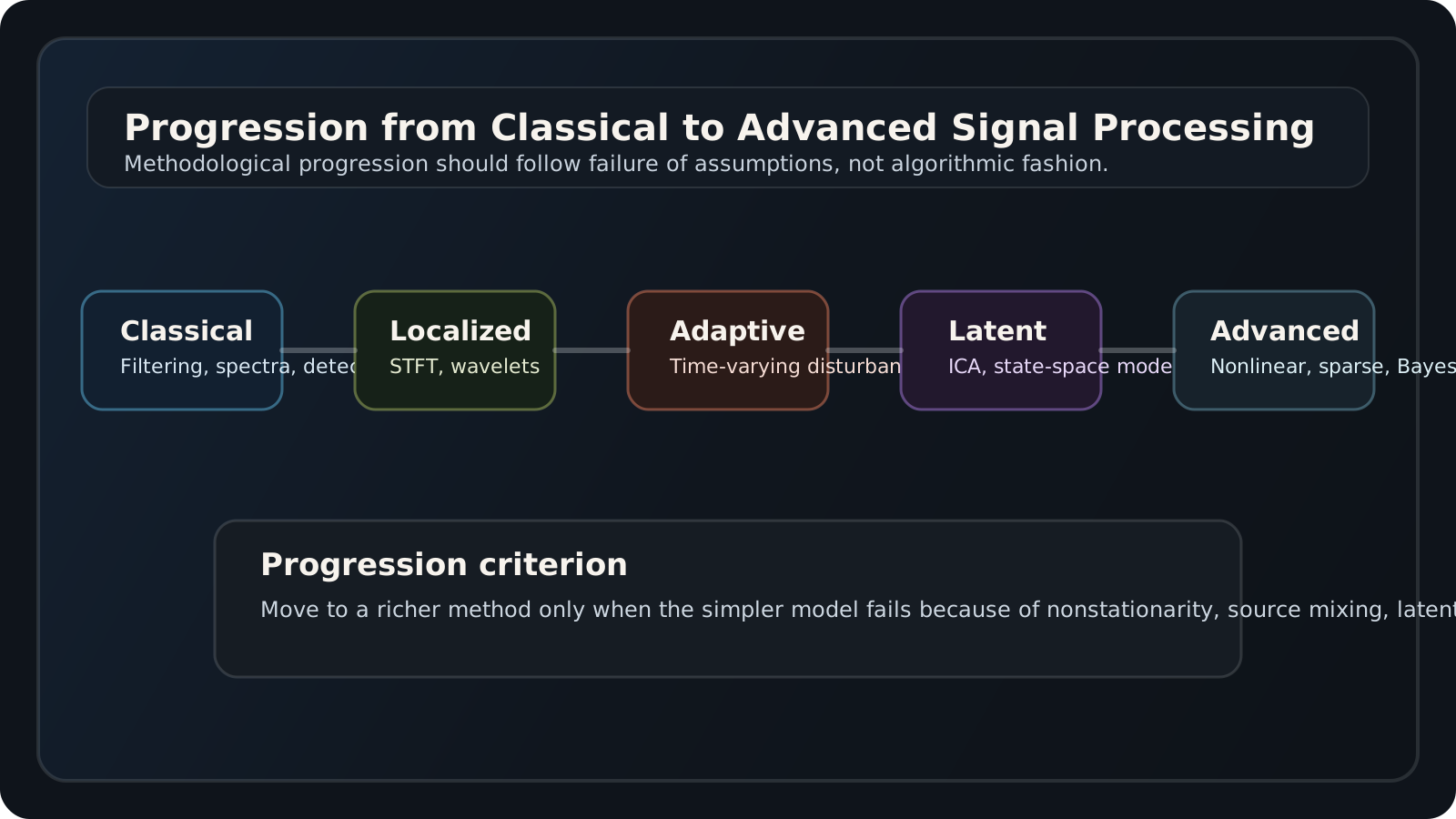
A principled progression
The most defensible path from classical to advanced signal processing is one of progressive model enrichment:
- begin with acquisition, filtering, and spectral representation;
- add localized methods when stationarity is no longer defensible;
- introduce adaptive methods when contamination becomes time-varying;
- move to source separation when channels are mixtures rather than sources;
- move to state-space and Bayesian methods when hidden physiological state is the real target;
- use nonlinear, decomposition-based, or sparse methods when the geometry of the problem truly requires them.
This sequence is not mandatory, but it is scientifically disciplined. Advanced methods are most valuable when classical foundations remain visible beneath them.
Closing perspective
Advanced signal processing for physiological data is not defined by complexity for its own sake. It is defined by the attempt to model what simpler methods leave unresolved: time variation, hidden state, source mixing, multiscale organization, nonlinear regulation, adaptive decomposition, and structured uncertainty.
For expert audiences, the real challenge is not whether these methods can be implemented. It is whether they improve inference. In physiological data analysis, that requires simultaneous attention to the signal chain, the instrument, the dynamical assumptions, the coupling structure, and the biological interpretation.
That is why the journey from classical to advanced signal processing matters. Classical methods teach what signals are. Advanced methods ask whether we are prepared to infer what those signals mean when the easy assumptions fail.