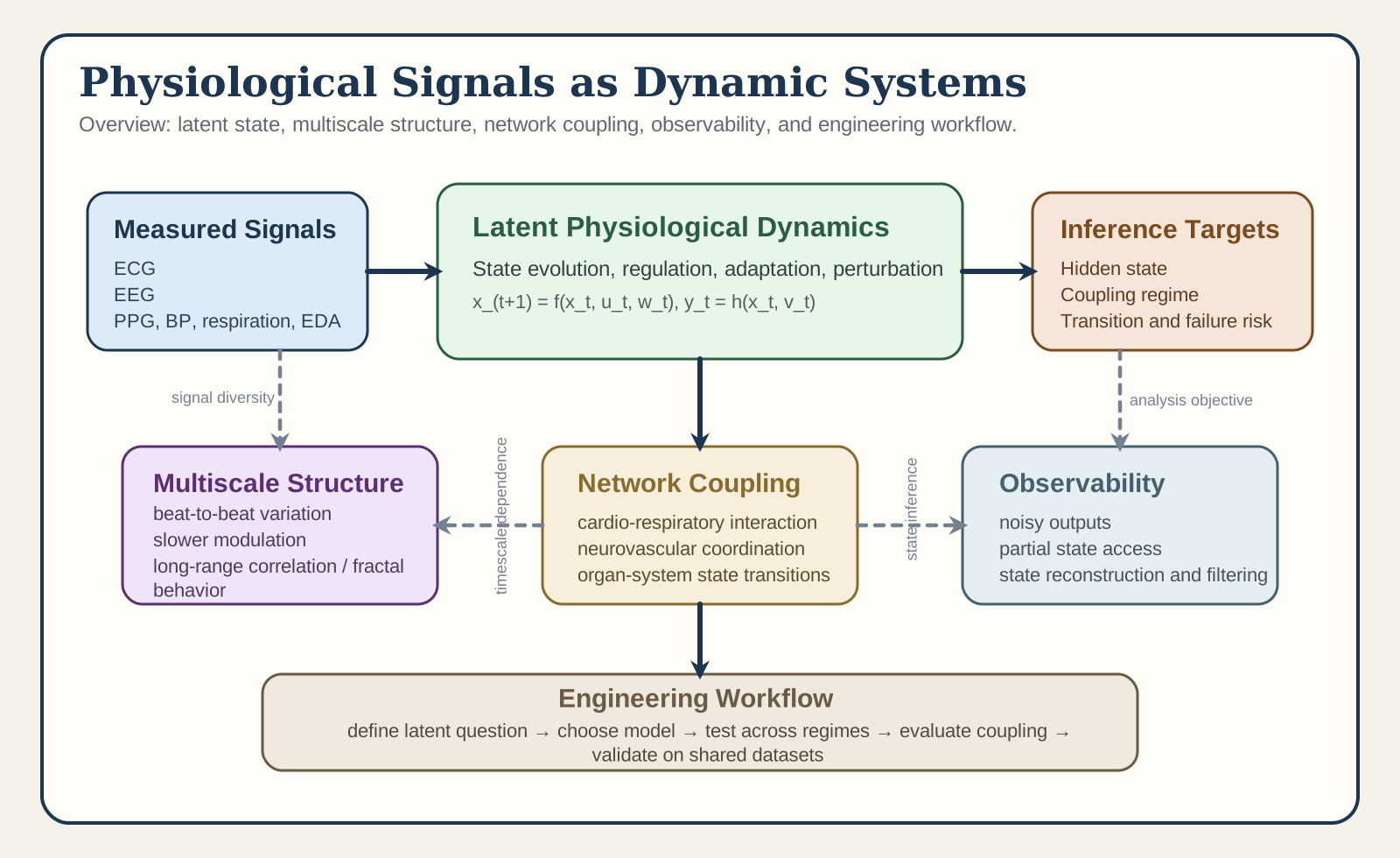
Physiological signals are often introduced as measurement streams: an ECG trace, an arterial pressure waveform, an EEG recording, a respiration channel, or an electrodermal activity signal. That viewpoint is operationally useful, but it is not sufficient for serious engineering or scientific analysis. A physiological signal is not merely a sampled curve. It is the observable output of a regulated, adaptive, multiscale dynamical system, often embedded in a larger network of interacting systems.
Once that shift in viewpoint is made, the analytical task changes substantially. The goal is no longer only to detect peaks, compute averages, or classify windows. The goal becomes to infer dynamics, constraints, couplings, and failure modes from imperfect observations of a changing biological process.
This systems view is not new, but it has become increasingly important. Healthy physiology is not characterized by constancy in the naive sense, but by structured variability, long-range correlations, and nonlinear organization across scales. In cardiovascular dynamics, neural recordings, and multimodal physiological monitoring, the signal of interest is typically generated by regulatory processes operating far from equilibrium, under feedback control, with state-dependent adaptation and intermittent perturbation.
Why the systems view matters
Suppose one records heart rate, respiration, and blood pressure from a subject over time. A static analysis can extract mean rate, variance, frequency-domain power, or a small set of handcrafted features. These quantities are useful, but they do not directly explain how the system moves through state space, how coupling changes across conditions, or why the same mean value can arise from fundamentally different regulatory regimes.
The dynamic-systems perspective starts from a different object:
where \(x_t\) is the latent physiological state, \(u_t\) is an external or endogenous drive, \(w_t\) is process disturbance, and \(y_t\) is the observed signal. Under this formulation, the raw physiological waveform is not the system itself. It is a projection of the system.
This distinction matters because measurement artifacts, partial observability, and subsystem coupling are the rule rather than the exception in biosignals. The ECG is not the heart, but an electrical manifestation of depolarization dynamics filtered through tissue and instrumentation. The PPG is not blood flow itself, but an optical surrogate coupled to vascular compliance, perfusion, and motion. The EEG is not cognition, but a scalp-level superposition of neural population activity, volume conduction, and noise.
Physiological signals are multiscale by construction
One reason physiological analysis is difficult is that biological regulation acts across multiple time scales simultaneously. In heart dynamics, beat-to-beat variation reflects local autonomic control, while slower circadian or behavioral modulation changes the broader operating regime. In neural recordings, oscillatory structure can coexist with transient bursts, state transitions, and nonstationary coupling. In respiration, a nominally regular rhythm can still be modulated by posture, exertion, arousal, and cardiopulmonary interaction.
The practical consequence is that a model tuned to one temporal resolution can miss critical structure at another. This motivates several engineering disciplines: avoid assuming stationarity over long windows unless it is justified, use representations that preserve or explicitly analyze scale structure, distinguish short-range variability from long-range correlation, and validate across operating states rather than only within one regime.
| Signal Family | What Is Measured | Typical Distortion | Systems Question |
|---|---|---|---|
| ECG | Electrical manifestation of cardiac depolarization | Motion, electrode quality, baseline wander | How does rhythm and regulation change across state and stress? |
| PPG | Optical surrogate of vascular pulsation | Motion, perfusion changes, ambient light | What does the trace say about circulation and autonomic state? |
| EEG | Scalp-level mixture of neural population activity | Volume conduction, muscle noise, electrode drift | How do oscillations and transitions reflect cognitive or physiological state? |
| EDA and respiration | Autonomic and ventilatory regulation | Sensor placement, contact quality, behavioral confounds | How are arousal, regulation, and external context interacting? |
Coupling is often more important than the individual channel
A second reason to think in dynamic-systems terms is that physiology is networked. The body is not a set of isolated modules, and the measured signals are therefore not independent observables. If the hypothesis concerns physiological state, resilience, or impending instability, then inter-signal coupling may be more informative than per-channel feature vectors alone.
That motivates a coupled formulation:
where \(x_t^{(i)}\) denotes the state of subsystem \(i\). The update of one subsystem may depend explicitly on the states of others. This is a more realistic representation of cardiopulmonary, neurovascular, or autonomic interactions than treating each channel independently.
The systems question is one of observability
From a control and systems perspective, physiological signal processing is fundamentally an observability problem. Given noisy outputs \(y_t\), what can be inferred about the latent state \(x_t\), the control structure, or the coupling regime?
This motivates state-space and latent-state approaches even when the ultimate model is statistical or learned. One does not need a perfect biophysical model to benefit from the systems viewpoint. The key is to preserve the distinction between observed waveform, latent physiological state, exogenous perturbation, measurement artifact, and control or coupling mechanism.
A practical engineering model might therefore take the form
for approximately linear local dynamics, or a nonlinear learned analogue when linear assumptions fail. What matters is not the specific estimator class, but the fact that inference is structured as state reconstruction rather than static summarization.
A concrete example: heart-rate variability
Heart-rate variability is often introduced through spectral bands or time-domain statistics. Those summaries remain important, but HRV is also a useful example of why physiological signals should be treated as outputs of a control system rather than as generic stochastic data.
If \(r_k\) denotes the \(k\)-th RR interval, then a simplistic model might treat
as a noisy random process. A more realistic view is that RR intervals are generated by an adaptive control system shaped by autonomic balance, respiratory coupling, baroreflex regulation, and slower contextual modulation. That means the observed sequence has memory, timescale structure, and state dependence.
This distinction is clinically and scientifically meaningful. Reduced variability is not always “cleaner.” In some settings, it reflects impaired adaptability rather than improved control.
A practical workflow for engineers
For engineers building physiological signal models, a useful workflow is:
- Define the latent dynamic question before choosing the model. Are you estimating hidden state, predicting transitions, quantifying coupling, or detecting control failure?
- Separate measurement model from system model. Distinguish sensor artifact, preprocessing assumptions, and biological interpretation.
- Preserve timescale structure. Avoid collapsing all information into one summary statistic unless the application truly permits it.
- Test across regimes, not only random folds. Physiological systems change with sleep stage, posture, exertion, stress, medication, and disease.
- Evaluate coupling when multiple channels exist. Joint dynamics may carry more information than isolated channels.
This workflow blocks a common failure mode in biomedical machine learning: building a high-performing model on static windows that does not correspond to the actual physiology generating the data.
A small code sketch
import numpy as np

T = 500
x = np.zeros(T)
y = np.zeros(T)
u = np.sin(np.linspace(0, 12 * np.pi, T))

for t in range(T - 1):
    process_noise = 0.05 * np.random.randn()
    measurement_noise = 0.08 * np.random.randn()

    x[t + 1] = 0.92 * x[t] + 0.25 * u[t] + process_noise
    y[t] = x[t] + measurement_noise
This is obviously not a physiological model in itself. Its value is conceptual: it reminds us that the measurement channel \(y_t\) is not the state \(x_t\), and that even a simple dynamic system can generate signals whose apparent behavior depends on hidden state, input, and noise simultaneously.
for t in range(T - 1):
    x_cardio[t + 1] = 0.9 * x_cardio[t] + 0.2 * x_resp[t] + 0.05 * np.random.randn()
    x_resp[t + 1] = 0.85 * x_resp[t] + 0.1 * u[t] + 0.05 * np.random.randn()
A multimodal extension makes the systems point even clearer: coupled states are often closer to real physiology than independent channels with late fusion.
Research implications
Treating physiological signals as dynamic systems has several implications for research and engineering practice. For signal processing, it prioritizes methods that preserve temporal structure rather than flatten it too early. For machine learning, it argues for sequence models, latent-state models, and mechanistically informed architectures where appropriate. For multimodal sensing, it shifts emphasis from independent channel analysis to dynamic coupling and coordinated state transitions. For evaluation, it demands datasets and benchmarks that span states, perturbations, and meaningful physiological variability rather than only clean nominal segments.
Conclusion
The phrase “physiological signals as dynamic systems” should be taken literally. Physiological data are not merely time-indexed values awaiting feature extraction. They are partial observations of adaptive, nonlinear, multiscale, and often networked regulatory systems.
For engineers, this means the central challenge is not only denoising or classification, but system inference under uncertainty. For researchers, it means that physiological interpretation improves when models respect observability, coupling, nonstationarity, and timescale structure. That shift in viewpoint does not make physiological signal analysis easier. It makes it more faithful to the systems that generate the data.