Robotics is frequently introduced through the visible surface of the field: motion, navigation, manipulation, and autonomy demonstrations. That framing is useful pedagogically, but it understates the engineering problem posed by deployed robotic systems. In practical settings, many robotic applications are not merely problems of movement; they are problems of closed-loop regulation over information, resources, timing, and contention.
This systems view is especially clear in intralogistics, where fleet-scale performance depends less on the local competence of individual robots than on the coordinated behavior of estimation, task allocation, planning, scheduling, execution, and recovery layers. This article reframes robotics as a hierarchical, constrained, stochastic control problem and uses intralogistics as a concrete case in which the systems nature of robotics becomes operationally visible.
Introduction
Robotics is often narrated through what is easiest to see: robot motion, manipulation, localization, or autonomous navigation. These are important elements, but they do not fully capture the central challenge of many deployed robotic systems. In operational environments, the main difficulty is often not whether a robot can move, but whether an entire system can sustain safe, efficient, and recoverable behavior under uncertainty, timing pressure, and resource contention.
This broader framing becomes especially important in intralogistics. Warehouse and fulfillment environments combine mobile robots, task queues, charging processes, shared infrastructure, order priorities, and traffic bottlenecks into one tightly coupled system. In such settings, performance emerges from the interaction of estimation, task allocation, planning, execution, and supervisory recovery rather than from the isolated excellence of any one module.
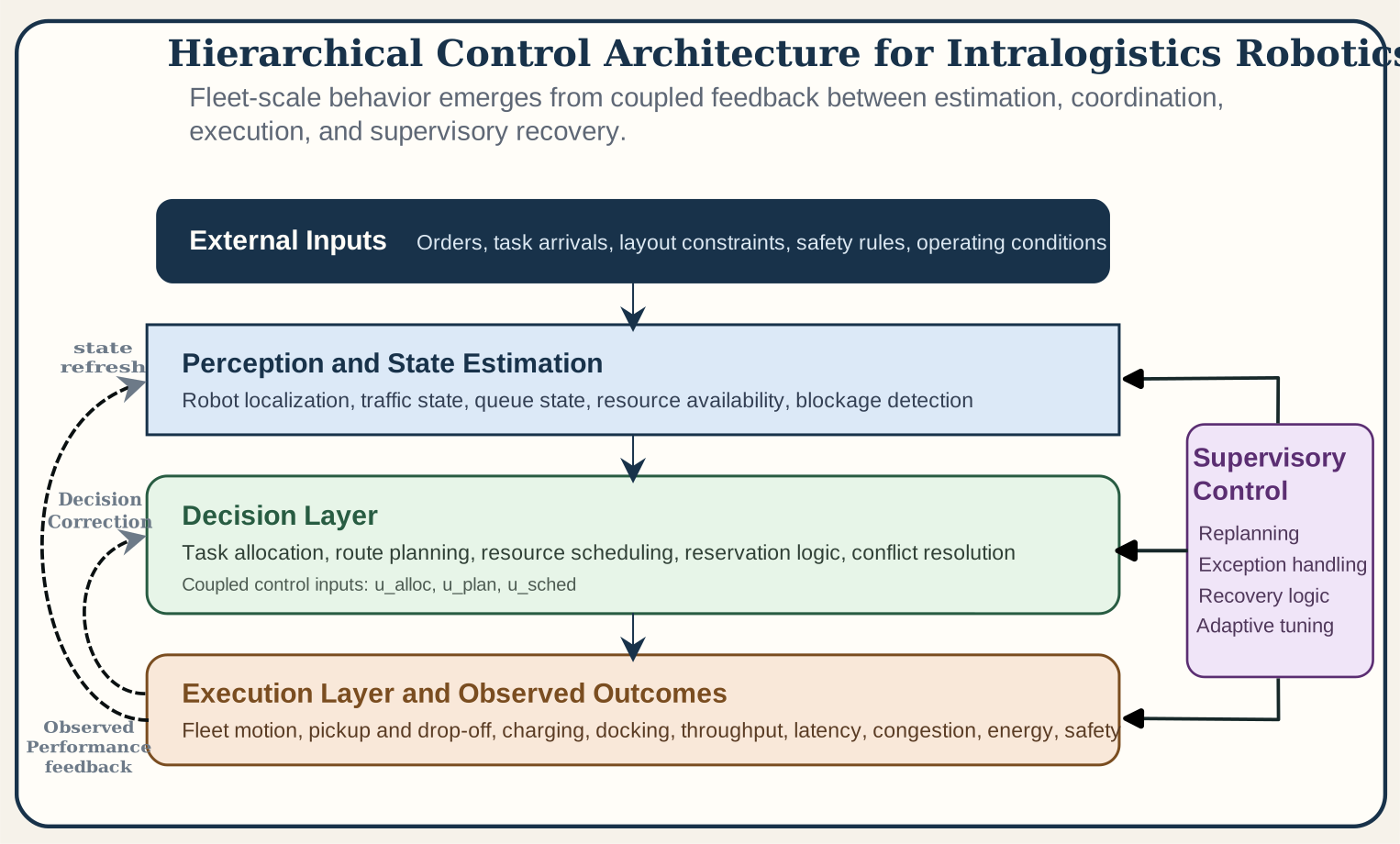
From Single-Robot Control to System Orchestration
Classical robotics and control theory often focus on stabilizing a plant, tracking trajectories, or rejecting disturbances at the level of a robot or subsystem. These remain essential foundations. However, in multi-robot operational environments, the effective plant is no longer a single machine. It is a networked socio-technical system composed of heterogeneous agents, shared spaces, software services, task demands, and physical constraints.
This shift matters because local optimality does not guarantee global efficiency. A route planner may minimize travel time for one robot while degrading fleet-wide flow through bottleneck formation. A dispatch rule may maximize immediate utilization while increasing downstream congestion or charging conflicts. A local recovery policy may solve one blockage while destabilizing throughput elsewhere. In other words, many important robotic failures are not failures of locomotion but failures of coordination.
Intralogistics as a Canonical Systems Problem
Modern intralogistics systems integrate autonomous mobile robots, fixed infrastructure, order management systems, charging logic, fleet coordination software, and human-operated stations. The system must continuously decide which robot should serve which task, how traffic should be routed through shared aisles, when resources such as chargers or doors should be reserved, and how execution should adapt to disturbances.
Accordingly, the main system metrics in intralogistics are not elegance of motion alone. They include throughput, task latency, congestion burden, resource utilization, energy efficiency, safety, and recovery quality. These are system-level performance variables. They are shaped by interdependencies across layers and cannot be understood solely through low-level motion competence.
Formal Problem Formulation
Consider a fleet of \(N\) robots operating in a shared warehouse graph \(G=(V,E)\), where nodes represent storage locations, workstations, chargers, pickup/drop-off points, and intersections, and edges represent traversable routes. At time \(t\), define the global state as
where:
- \(x_t^{(r)}\) denotes robot states, including pose, velocity, battery level, payload status, and current task
- \(x_t^{(q)}\) denotes task-queue states, including pending orders, priorities, and deadlines
- \(x_t^{(e)}\) denotes traffic and environmental states, including aisle occupancy, congestion, and temporary blockages
- \(x_t^{(i)}\) denotes infrastructure states, including doors, elevators, docking stations, and charger availability
The control input is hierarchical:
where:
- \(u_t^{\text{alloc}}\): task-to-robot assignment
- \(u_t^{\text{plan}}\): path or route planning decisions
- \(u_t^{\text{sched}}\): resource and timing schedules
- \(u_t^{\text{exec}}\): low-level motion and execution commands
The system evolves under uncertainty as
where \(w_t\) captures disturbances such as localization error, communication delay, bursty task arrivals, or blocked paths.
A fleet-level policy \(\pi\) seeks to minimize long-horizon operational cost:
subject to collision avoidance, safety constraints, battery and charging constraints, task precedence constraints, and resource capacity constraints.
Here, \(L_t\) denotes latency or service-delay cost, \(C_t\) congestion cost, \(E_t\) energy cost, \(R_t\) recovery burden or operational risk, and \(Q_t\) throughput or service reward.
System Layers and Their Characteristic Control Problems
| System Layer | Core Decision Variables | Primary Objective | Representative Failure Mode |
|---|---|---|---|
| Perception and state estimation | Robot pose, obstacle state, queue state, congestion state, infrastructure availability | Maintain accurate, timely system state estimates | Mislocalized robots or stale traffic estimates causing avoidable replanning |
| Task allocation | Robot-task assignments, reassignment rules, priority handling | Maximize service efficiency and throughput | Myopic assignment that increases downstream congestion |
| Path planning and traffic coordination | Routes, reservations, right-of-way rules, replanning triggers | Avoid collisions while limiting travel and congestion cost | Deadlock or bottleneck formation |
| Resource scheduling | Charger access, docking windows, workstation occupancy | Balance utilization of shared resources | Charger contention or blocked stations |
| Low-level execution and control | Velocity commands, tracking policies, stop/go decisions | Safe and accurate motion execution | Tracking error that spills into system-wide delay |
| Supervisory control and recovery | Exception handling, rerouting, failover, task rollback | Preserve continuity under disturbances | Local recovery that resolves one issue while destabilizing another zone |
The table highlights an important systems insight: each layer has its own objective, but the warehouse only performs well when those objectives remain mutually compatible. A mathematically elegant local planner can still produce weak system performance if its routes create conflict patterns that the scheduler or allocator cannot absorb.
Why Coordination Bottlenecks Dominate Real Performance
One of the most useful corrections to common robotics narratives is that many operational problems are not caused by weak locomotion or poor kinematics. They are caused by shared-resource contention. Robots compete for bottleneck corridors. Charging demand clusters at the wrong time. A valid local plan becomes globally harmful when many robots attempt to execute similar actions simultaneously. Recovery logic that is sensible locally may shift congestion or queue imbalance elsewhere.
From this perspective, the core challenge is not only safe motion but regulated flow. That is why congestion-aware planning and reservation-based coordination have become so important in warehouse robotics.
Local Optimality Versus Global Optimality
A central systems phenomenon in intralogistics is the divergence between local and global optimality. The shortest path for one robot is not necessarily the best decision for the fleet. If many robots choose the same locally efficient corridor, the result may be bottleneck formation, queue spillback, and reduced throughput. By contrast, a globally coordinated policy may assign some robots slightly longer routes while improving overall flow and service quality.
This difference is conceptually important because it explains why single-robot benchmarking often overstates deployment readiness. A local navigation stack may be excellent and yet fail to produce strong warehouse-level performance if it ignores coordination, reservation, and shared-resource timing.
Implications for Robotics Research
Viewing robotics as a system-level control problem changes the scientific agenda. It suggests that four directions deserve particular emphasis.
- Coordination-aware estimation should infer not only robot pose but also traffic state, bottleneck risk, and resource contention.
- Throughput-aware task allocation should anticipate downstream effects rather than optimize only immediate travel or priority score.
- Lifelong planning under operational churn should handle continual task arrivals, route conflicts, and disturbances without collapsing scalability.
- Recovery-by-design should be treated as a primary architectural objective because robust intralogistics systems derive much of their value from graceful degradation rather than brittle optimality.
This framing also helps unify robotics subfields that are often treated separately. Perception, planning, scheduling, and control are not independent modules connected in a linear pipeline. They form an interacting closed loop whose quality is best judged by system-wide behavior over time.
Conclusion
The most useful way to interpret intralogistics robotics is not as a collection of mobile robots moving through a warehouse, but as a hierarchical closed-loop system that regulates flow, timing, contention, and recovery under uncertainty. This is what makes intralogistics a revealing case study for robotics more broadly. It exposes the fact that many of the hardest problems in robotics are not purely geometric or kinematic. They are system-level control problems.
A robot fleet succeeds not when each unit moves well in isolation, but when the full architecture of estimation, assignment, planning, execution, and recovery remains sufficiently coordinated to preserve safety, throughput, and resilience over time. In that sense, intralogistics does more than provide an application domain. It offers a clear empirical lens through which the systems nature of robotics becomes visible.