Robotics is often described through algorithms: planning, control, perception, learning, estimation. That description is incomplete. Modern robot systems are built not only from methods, but from frameworks that make those methods executable, observable, reproducible, and interoperable. In practice, many failures attributed to "the algorithm" are better understood as failures of composition across middleware, simulation, visualization, and experimental infrastructure.
For that reason, robotics should be read as a software ecosystem problem as much as an algorithmic one. A planner without a stable world model, a simulator disconnected from the runtime stack, or a perception module that publishes opaque outputs into the graph is not merely inconvenient. It changes the scientific quality of the system by making behavior difficult to inspect, compare, and validate.
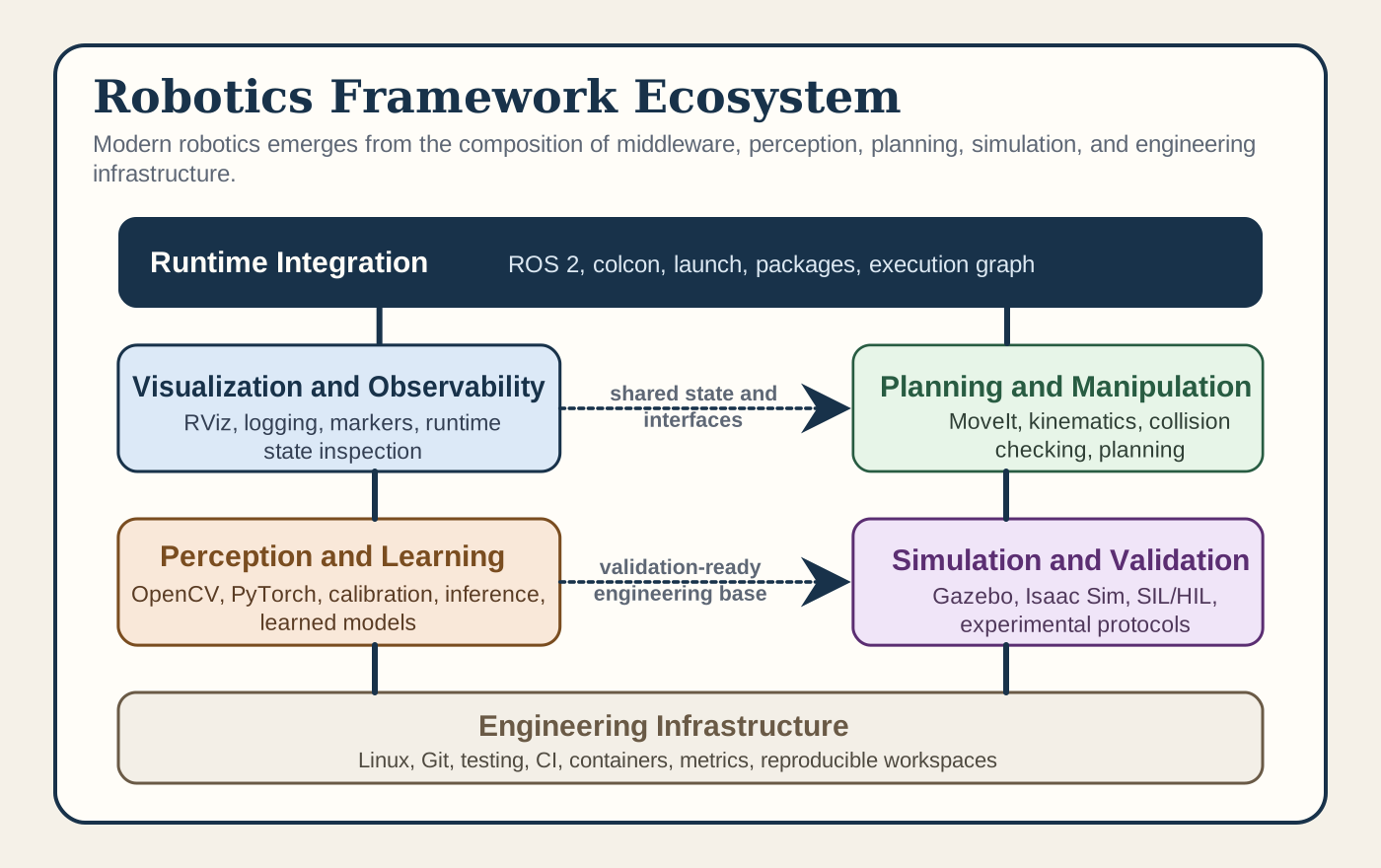
Robotics as a Framework Ecology
At a useful level of abstraction, a robot can be written as
This compact formulation already implies multiple software layers:
- a runtime system to move data between components
- a perception layer to transform sensor streams into state estimates
- a planning and control layer to generate behavior
- a simulation layer to evaluate behavior before hardware execution
- a visualization and logging layer to expose internal state
- an engineering layer for builds, tests, packaging, and reproducibility
No single framework spans all of these concerns well. That is not an accident. Robotics is an embodied systems discipline, and embodied systems resist monolithic software abstractions. The practical result is that robotics development depends on a framework ecology: several frameworks, each strong in one layer, coupled through shared interfaces and disciplined engineering practice.
A First Map of the Ecosystem
A useful decomposition of the framework ecosystem looks like this:
| Layer | Primary Role | Representative Frameworks |
|---|---|---|
| Runtime integration | Communication, orchestration, execution graph | ROS 2, colcon, launch |
| Visualization | Runtime introspection and debugging | RViz, logging tools |
| Planning and manipulation | Kinematics, collision checking, trajectory generation | MoveIt, planning backends |
| Perception | Image processing, learned models, calibration | OpenCV, PyTorch |
| Simulation | System-level testing and validation before hardware | Gazebo, Isaac Sim |
| Engineering infrastructure | Packaging, testing, reproducibility | Git, CI, Linux tooling |
This table is not merely descriptive. It explains why robotics development is so often constrained by interfaces between frameworks. Poor systems are frequently limited not by the quality of one framework, but by mismatches between adjacent layers.
The Central Frameworks
The most important frameworks are not necessarily the most fashionable. They are the ones that repeatedly occupy the critical path from prototype to experiment to deployment.
ROS 2: Middleware as System Spine
ROS 2 remains the most important general-purpose robotics middleware. The official documentation describes it as a set of software libraries and tools for building robot applications, and the currently released documentation points to Kilted as the active stable release while Rolling remains the development branch.[1]
Its importance is architectural. ROS 2 supplies the abstractions that allow a robotics system to be decomposed into communicating processes:
- nodes for modular execution
- topics for streaming data
- services and actions for request-response and task-level interaction
- launch descriptions for orchestration
- package conventions for system organization
In practical terms, ROS 2 is the integration spine of a large class of robot systems. It does not solve planning, estimation, or learning directly. It solves the equally important problem of how those components coexist.
colcon: Reproducibility Through Workspace Discipline
In ROS 2 development, colcon is the standard build and workspace tool.[2] That sounds procedural, but the implications are deeper. In robotics, reproducibility problems often appear first as workspace problems: unresolved dependencies, broken overlays, environment drift, or non-portable build assumptions.
If a robotics project cannot be built cleanly from a fresh workspace, then its experimental claims are already compromised. colcon matters because it stabilizes the build layer that the rest of the software stack stands on.
RViz: Runtime Introspection as an Engineering Primitive
RViz is the standard visual debugging environment in the ROS ecosystem.[3] Its importance lies in the visibility it provides into otherwise opaque system state:
- frame transforms
- robot state and geometry
- sensor streams
- trajectory outputs
- markers, paths, and inferred geometry
This may seem secondary compared to planning or learning, but in practice a large fraction of robotics engineering consists of making intermediate state inspectable soon enough to correct integration errors. RViz is one of the frameworks that turns debugging from guesswork into observation.
MoveIt: Manipulation Infrastructure
MoveIt remains one of the most important manipulation frameworks in robotics. Its official site describes it as a motion planning, manipulation, and kinematics framework for ROS, and it currently lists MoveIt Jazzy as the latest stable recommended release.[4]
Its value is not merely that it contains planners. Its deeper value is that it organizes the infrastructure around manipulation:
- robot models and kinematic semantics
- inverse kinematics interfaces
- collision checking
- motion planning requests and execution
- scene representation and debugging hooks
For manipulation research, MoveIt matters because it reduces the amount of surrounding infrastructure a team has to rebuild before it can ask a meaningful research question.
Gazebo and Isaac Sim: Simulation as Validation Environment
Simulation frameworks are often introduced as convenience tools. That framing is too weak. In serious robotics work, simulation is part of the validation infrastructure.
Gazebo Harmonic is currently documented as a long-term release and remains highly relevant for ROS-native experimentation and iterative integration.[5] Isaac Sim is increasingly important when teams require physically based environments, high-quality sensor simulation, or software-in-the-loop and hardware-in-the-loop workflows.[6]
These frameworks occupy different positions in the ecosystem:
- Gazebo is strong when open workflows, ROS compatibility, and iterative systems integration are the primary concerns
- Isaac Sim is strong when sensor realism, digital twins, and higher-fidelity simulation pipelines are central
The essential point is that simulation frameworks are not just visualization platforms. They are experimental surfaces where hypotheses can be tested under controlled conditions.
OpenCV and PyTorch: The Perception Spectrum
OpenCV remains one of the most important perception libraries in robotics. Its official documentation presents it as an open-source computer vision library with a broad modular structure spanning core functionality, image processing, and image I/O.[7] This matters because a large amount of robotics perception still depends on efficient classical or hybrid pipelines such as calibration, filtering, contour extraction, geometric transforms, and low-latency pre-processing.
PyTorch remains the dominant experimentation framework for learning-heavy robotics groups. In robotics, it rarely constitutes the whole system. Rather, it typically occupies the learning layer: representation learning, detectors, policies, and offline model development before deployment integration.[8]
A Minimal Example of Composition
The best way to understand an ecosystem is to observe a small but real composition of frameworks performing useful work. A simple perception-diagnostics node already teaches a lot: ROS 2 provides communication, colcon provides reproducible workspace structure, cv_bridge couples the ROS graph to image-side computation, OpenCV performs local analysis, and RViz or CLI tools expose downstream effects.
Framework Selection Should Follow Interface Pressure
A more expert way to choose tools is to choose them by the interface pressure they resolve.
| Need | Choose | Reason |
|---|---|---|
| Modular runtime and message flow | ROS 2 |
It provides the communication spine of the system |
| Stable workspace builds | colcon |
It keeps packages, overlays, and tests reproducible |
| Fast visibility into hidden state | RViz |
It turns geometry, transforms, and trajectories into inspectable objects |
| Manipulation and arm planning | MoveIt |
It organizes kinematics, collision checking, and execution infrastructure |
| ROS-native simulation | Gazebo |
It fits iterative integration and open robotics workflows well |
| High-fidelity sensor-rich simulation | Isaac Sim |
It supports digital-twin and SIL/HIL style validation |
| Efficient classical vision | OpenCV |
It covers calibration, filtering, geometry, and low-latency image work |
| Learned perception or policy experiments | PyTorch |
It is the dominant experimentation layer for model development |
This is the real ecosystem lesson: frameworks are chosen less by trend than by the interfaces they stabilize.
Final Takeaway
The robotics software ecosystem is not valuable because it is large. It is valuable because it provides reusable interfaces for building reliable loops between design, implementation, observation, and validation.
Used separately, these are just frameworks. Used together, they form a serious robotics engineering environment.